Husky or Malamute? How to Tell Them Apart at the Dog Park
Published · Last updated
Someone at the park points at a big gray-and-white dog and says "beautiful husky." The owner smiles, or sighs, and says "malamute."
Here's how to be the person who gets it right. A Siberian Husky and an Alaskan Malamute are two different breeds. They share a thick coat, a curled tail and a job in the snow, and that's where a lot of the mix-ups start. Size, eyes, tail and the work they were bred for will usually settle it.
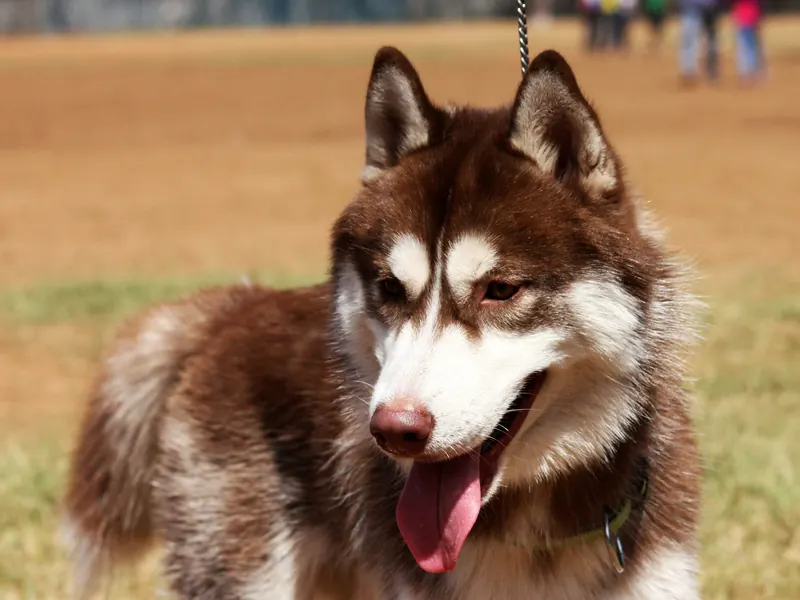
Bowie, my husky girl, shows one of the easiest tells. She has one blue eye and one brown eye. Siberian Huskies are allowed to have blue eyes, brown eyes, or one of each. Malamutes are not. A purebred Malamute's eyes should be brown, and the breed standard rules out any dog with blue eyes.
Key takeaways
- Siberians are medium-sized distance dogs. Malamutes are larger freighting dogs (AKC).
- A male Siberian is 21 to 23½ inches at the shoulder and 45 to 60 pounds. The desirable freighting size for a male Malamute is 25 inches and 85 pounds (SHCA standard, AMCA).
- Siberians may have brown eyes, blue eyes, one of each, or a split eye. Malamutes have brown eyes. Blue eyes disqualify a Malamute (AKC Malamute standard).
- A Siberian's tail is a fox-brush, often in a sickle curve when the dog is alert. A Malamute's tail is a waving plume over the back.
- If you still can't tell, you may be looking at a mix, or at an Alaskan Husky, which is a working type, not an AKC-recognized breed.

How can you tell them apart by size?
This is the fastest tell, and it's the one people miss when they expect every "husky" to be huge.
The official Siberian Husky standard, also on the AKC breed page, puts a male at 21 to 23½ inches at the withers and 45 to 60 pounds. A female is 20 to 22 inches and 35 to 50 pounds. Dogs over those heights are disqualified in the show ring. Bowie sits in that medium, athletic range. She does not look like a freighting dog, and she shouldn't.
The Alaskan Malamute Club of America follows the AKC standard's desirable freighting size: 25 inches and 85 pounds for a male, and 23 inches and 75 pounds for a female (AKC standard, PDF).
If the dog looks like it could pull your car out of a ditch, lean malamute. If it looks like a light, quick athlete, lean Siberian. Lenore Demmin, then president of the Siberian Husky Club of America, put it the way I think of it too: the Siberian is the marathon runner, and the Malamute is the weightlifter (AKC).
What about the eyes?
Bowie's face does some of the teaching for me. One blue eye, one brown eye. That's completely acceptable in a Siberian. The standard allows brown eyes, blue eyes, one of each, or a parti-colored eye (SHCA).
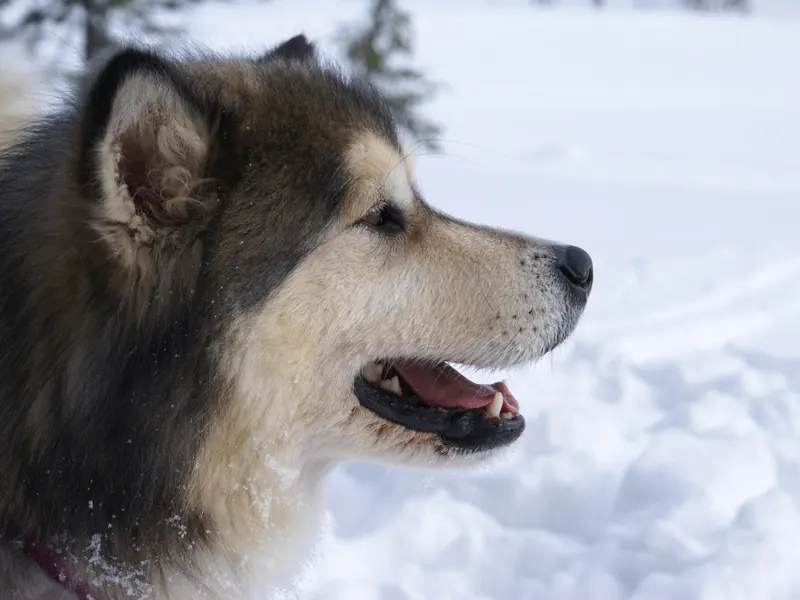
Malamutes have brown, almond-shaped eyes, with dark eyes preferred. Blue eyes are a disqualifying fault (AKC Malamute standard). So an ice-blue stare on a big sled dog usually means a Siberian, or a mix. It does not mean a purebred Malamute.
How is the tail different?
A Siberian carries a well-furred tail in a fox-brush shape. When the dog is alert, it's usually in a graceful sickle curve over the back. When the dog is relaxed, the tail often trails down. That's in the standard, and it's what I see on Bowie when she switches off.
A Malamute's tail is a well-furred plume, carried over the back, with "the appearance of a waving plume" (AMCA). It should not be a tight curl, and it is not a fox brush.
Why are huskies and malamutes so different?
The two breeds were built for different work, in different places.
Siberians come from the Chukchi people of northeastern Siberia, who needed dogs that could pull a light load a long way without eating much (AKC, SHCA). Every part of a Siberian is about efficiency.
Malamutes come from the Mahlemut people of northwestern Alaska and were bred to haul heavy freight over shorter distances (AKC, AMCA). That's why a Malamute looks more substantial: broader head, bulkier muzzle, heavier bone.
This short film of Alaskan Malamutes in harness is a good look at that freighting job. It's from Robin Li's channel, and we found it while gathering husky and northern-breed videos. Local Husky isn't affiliated with the channel.
If you'd rather watch Siberians at work, we have a page on training mushing commands.
What should you listen for?
Neither breed is a big barker. Both howl, and both "talk" in long, opinionated grumbles. The AKC comparison notes that many Malamutes sing a "woo-woo" when it's time to eat, run or play. Siberians are more likely to announce, at full volume, that you've betrayed them by putting the leash away.
I wouldn't hang a whole identification on the voice alone. Use it as a hint, after you've looked at size and eyes.
Could it be a mixed breed or an Alaskan Husky?
You may be looking at a mix. Plenty of dogs in shelters are husky mixes with a Malamute, a German Shepherd, or something nobody can name.
Or you may be looking at an Alaskan Husky. That's a working sled-dog type, not an AKC-recognized breed. Mushers breed those dogs for speed and stamina, so the looks vary a lot.
A DNA test can give you a rough answer. The dog won't care either way.
When I'm out with Bowie, the eyes do most of the work. One blue, one brown: that's a Siberian face, not a Malamute's. Once you know the tells, you stop needing a guess.
Where we get our information
The sizes, eyes, tails and disqualifications come from the official breed standards, published by the AKC, the Siberian Husky Club of America and the Alaskan Malamute Club of America, linked throughout. The marathon-runner and weightlifter comparison comes from the AKC's husky-versus-malamute article, with comments from the national breed clubs. If a breeder or a breed club tells you something more specific about an individual dog, listen to them.
Frequently asked questions
Are huskies and malamutes the same breed?
No. They are two recognized breeds, with different origins, different jobs and different standards. They can look similar at a glance, which is why the mix-ups happen. The AKC walks through the differences, and so do the Siberian Husky Club of America and the Alaskan Malamute Club of America.
Can a malamute have blue eyes?
Not in the breed standard. Blue eyes are a disqualifying fault in the Alaskan Malamute (AKC standard, PDF). A dog with blue eyes, or one blue and one brown like Bowie, is not a purebred Malamute.
Which is bigger, a husky or a malamute?
The malamute. A male Siberian's upper limit is 23½ inches and 60 pounds. A male Malamute's desirable freighting size is 25 inches and 85 pounds. Females are smaller in both breeds, and the gap is still easy to see.
What is an Alaskan Husky?
An Alaskan Husky is a working sled-dog type, not an AKC-recognized breed. The dogs are bred for performance, so they don't all look the same. If the dog at the park doesn't quite match either standard, that may be what you're looking at, or a mix.
How can I tell if my dog is a husky or a malamute?
Start with size, then look at the ears, tail, coat and eyes. A Siberian Husky is a medium-sized dog with ears that stand straight up and a bushy tail. An Alaskan Malamute is a larger, heavier dog with ears that point slightly forward and a plumed tail that waves over its back. Both breeds have a thick double coat (AKC, SHCA standard, AMCA). Siberians can have brown eyes, blue eyes, one of each, or eyes that are part blue and part brown. A Malamute's eyes should be brown, and the breed standard disqualifies blue eyes (SHCA standard, AKC Malamute standard).
Bowie is a Siberian Husky. She is medium-sized, and her one blue eye and one brown eye settle it for us.
What's the bottom line on huskies and malamutes?
Start with size, then check the eyes and the tail, and think about the job the dog was built for. A medium, quick dog with a fox-brush tail is probably a Siberian. A heavier dog with brown eyes and a plumed tail is probably a Malamute. And if you're still guessing, that's all right. The dog doesn't mind, and there's a good chance you're looking at a mix.
If you're thinking of bringing one home, start with a rescue. The Local Husky Finder lists shelters, husky and malamute rescues, and breed clubs. If you love huskies as much as I do, come read more stories about Bowie and husky life on the blog.